CONSULTING
The brief
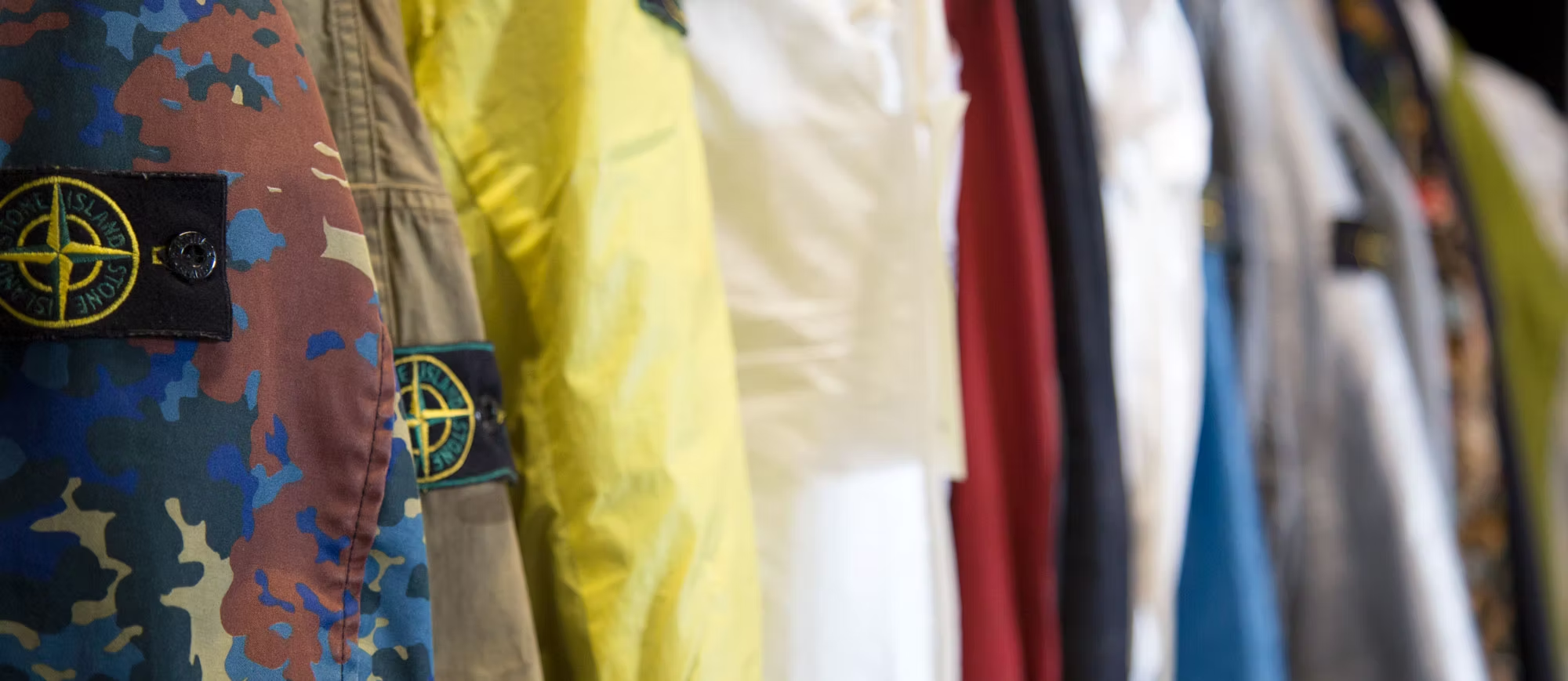
The WMA was seeking to better understand its users to build on past successes, determine what might need updating, and develop more formalised ways of engagement, emphasising commercially oriented parties.
Image credit: Westminster Menswear Archive
STRATEGY
The original brief outlined a project over 5 phases between May and August 2025 covering: Stakeholder interview and surveys, Benchmarking study, Develop access & charging framework, Pilot implementation with industry partners, and Final report and recommendations. This was reshaped via the proposal which included extending the project length into the autumn due the summer holidays with many industry partners inaccessible. A phase 0 was integrated to diagnose and clarify the challenge at hand, phases 1 and 2 were conflated into a significant contextualisation phase with more varied data points, piloting and design development were not ultimately feasible, instead favouring the depth of detail extracted from the data, however a series of testimonials was added based on recommendations from the Impact Evaluation project which occurred in parallel. Given the project reorganisation, a framework has been proposed herein which includes some next steps and strategic recommendations.
DIAGNOSTIC
- Reshaping the project objectives; identifying project risks; mapping with milestones and touch-points; establishing communication methods; reviewing and analysing client material; connecting with stakeholders; determining additional resource needs.
CONTEXTUALISATION
- Reviewing and mapping desktop sources: Annual reviews, past exhibitions, research and consultancies, communications and files, online research.
- Observation and intercepts: users engaging with the archive.
- Workshops x 3: WMA strengths, 3-year plan + revenue streams, user journeys + pain points.
- Data collection: 13 one-to-one interviews with industry professionals, academics, archivists, and 'hybrids' (pro + academic).
- Custom anonymous online survey.
FRAMEWORK
- Analysis: desktop materials, field notes, workshop outputs, transcripts, testimonials, survey results.
- Drafting: filtration model, user filtration platforms, fee structure proposition, infrastructure shift.
- Proposing: interactive framework model, recommendations, user journey maps, workshops, roadmap.
REPORT
Materials from the past project phases were compiled into a report, supported by annexes, all raw materials, and the framework, for a client presentation.
Feedback was then incorporated for the final delivery materials.
„Sed pede ullamcorper amet ullamcorper primis, nam pretium suspendisse neque, a phasellus sit pulvinar vel integer.”
— Andrew Groves, Professor of Fashion Design at the University of Westminster and Director of the Westminster Menswear Archive
„Sed pede ullamcorper amet ullamcorper primis, nam pretium suspendisse neque, a phasellus sit pulvinar vel integer.”
— Dr. Danielle Sprecher, Curator of the Westminster Menswear Archive
CARTIER
The “Aleph“ concept was created with an aim to inspire visitors’ curiosity, deepen existing clients’ interest, and improve the in-store experience; by allowing clients to connect to Cartier creations that are not physically present in the boutique.
As this was a new direction for Cartier, a test period in a live environment was required to determine how well the Aleph concept fits into the Cartier boutique experience.
We set about to gain a deeper understanding of the device’s introduction and to determine:
- How it impacts on client behaviours
- How it affects working of teams in the boutique
- Whether the delivery method is optimally designed
Prototype images via Cartier Innovation Lab NYC
DESIGN RESEARCH
Role: Head of Sector | Project Lead ⏹ Client: Cartier North America Retail Innovation Lab
- METHODOLOGY
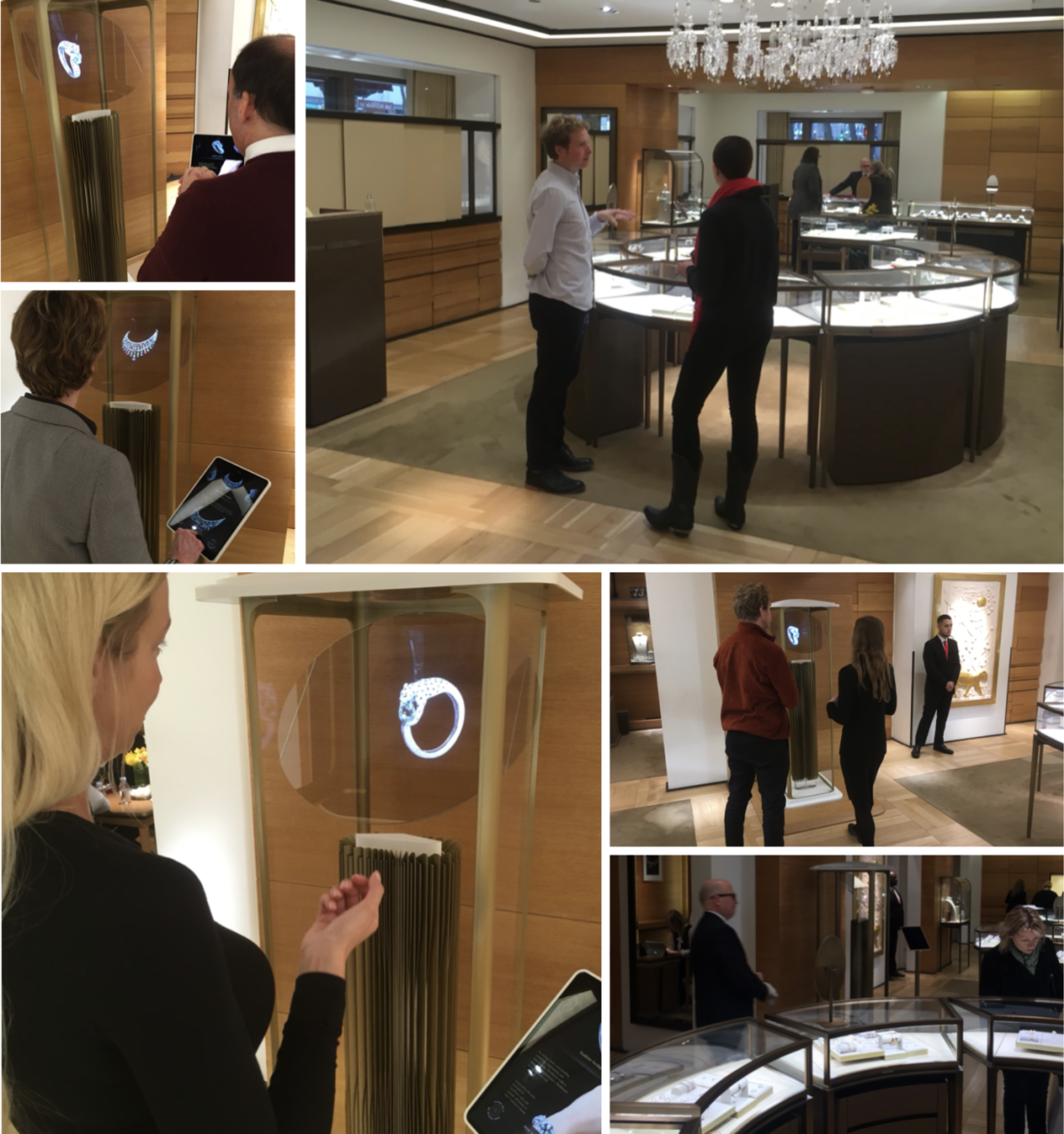
A team of design researchers from DK&A were sent to Cartier’s Chicago boutique on two separate occasions pre- and post-Aleph installation. - RESEARCH ACTIVITIES
Baseline boutique experience - 5 days in-boutique: observations; 40+ client intercepts; 8+ sales associate intercepts. Aleph boutique experience - digital survey: 13 staff reported stories & observed interactions. Aleph boutique experience - 4 days in-boutique: observations; 40+ client intercepts; 8+ sales associate intercepts; 9 1:1 client interviews. - CONCLUSIONS
The Aleph: a concise synthesis of the research analysis was provided; Key recommendations: a list of design iterations were offered aimed at enabling a public roll-out of the Aleph. - IMPACT
Won bid over 3 US-based market research firms as a late comer; Re-directed the client brief from quantitative to qualitative focus, transformed research approach; Results presented to the CEO and at Cartier global event; Following outcomes CEO expanded project to 4 prototypes in the same number of cities; Took on board key design recommendations.
„Sed pede ullamcorper amet ullamcorper primis, nam pretium suspendisse neque, a phasellus sit pulvinar vel integer.”
— Andrew Haarsager, former Head of Cartier Retail Innovation Lab NYC